Platform
Services
Solutions
Resources
Company
Implementation of a CI/CD pipeline has become a fundamental practice, but it is essential to pay attention to security in this process!
In the current scenario of software development, speed and quality in application delivery are essential factors for the success of any organization. In this context, implementing a CI/CD pipeline (Continuous Integration and Continuous Deployment) has become a fundamental practice, allowing development teams to deliver software faster and more efficiently.
However, speed cannot be achieved at the expense of security. Growing concern about cyber threats and privacy regulations, require security to be a priority from the beginning of the development cycle. This is where implementing a CI/CD pipeline securely becomes crucial to ensuring software quality, security, and compliance.
This article aims to explore the main challenges of implementing a CI/CD pipeline securely. We'll look at how security can be built into each CI/CD pipeline stage, from build to deployment.
We'll also discuss the importance of automation and continuous monitoring to ensure early detection of vulnerabilities and rapid response to potential threats.
Be prepared to embark on a journey that aims to unite the speed of continuous delivery with the strength of security. Let's dive into the strategies and tools that will allow you to safely implement a CI/CD pipeline, ensuring your applications are robust and reliable.
Deploying a CI/CD pipeline securely presents some challenges that must be addressed to ensure adequate software protection. Some main challenges include:
When facing these challenges, development teams can implement a CI/CD pipeline that effectively integrates security, protecting software from threats and ensuring quality and compliance throughout the development and deployment process.
Automation and continuous monitoring are key in ensuring early detection of vulnerabilities and rapid response to potential threats in a CI/CD pipeline. These practices are essential to strengthen software security and minimize the impacts of potential security incidents. Here are some points that highlight the importance of automation and continuous monitoring in this context:
In summary, automation and continuous monitoring are key elements to ensure CI/CD pipeline security. These practices enable early detection of vulnerabilities, rapid response to potential threats, and implementation of proactive protection measures, strengthening software security at all stages of the development and deployment cycle.
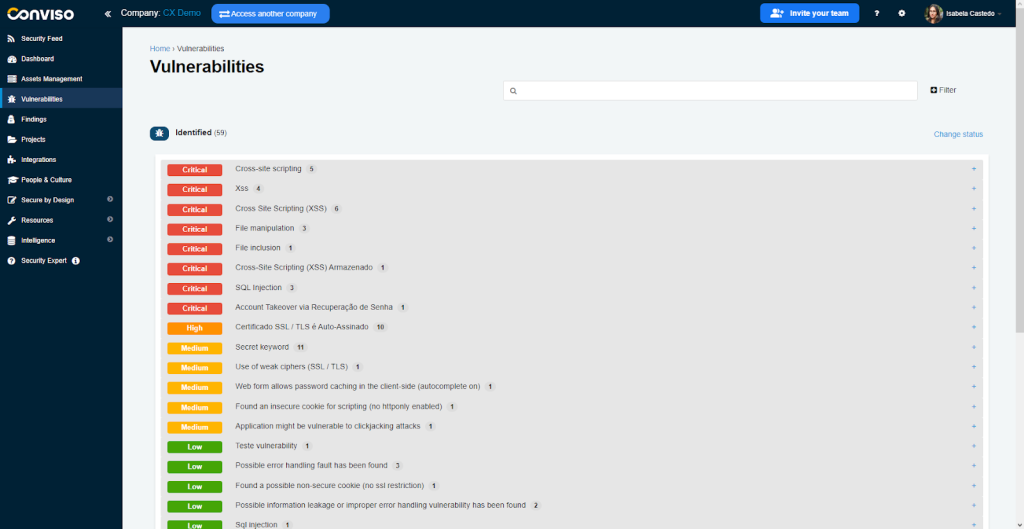
The Conviso Platform presents itself as an important tool in this context, giving the user the opportunity to have at hand, on a single platform, the most important tests mentioned, in addition to enabling efficient management of vulnerabilities.
It is also possible to integrate with the most popular tools on the market and import results in the SARIF format, a standard established by the market.
Implementing a CI/CD pipeline securely is an essential requirement in today's software development, where speed, quality, and compliance are critical to an organization's success. In this article, we explore the challenges and best practices for achieving this goal.
We identify key challenges such as vulnerability detection and remediation, security tool integration, key and credential management, security and regulatory compliance, security monitoring, and culture. Each of these challenges requires specific approaches and the adoption of appropriate practices.
We highlight the importance of automation and continuous monitoring as crucial elements to ensure early detection of vulnerabilities and rapid response to potential threats. Automating security tests and integrating appropriate tools into the pipeline allows you to identify and fix vulnerabilities at early stages of the development cycle.
In addition, the continuous monitoring of production environments and the implementation of intrusion detection systems allow an agile response to suspicious events, minimizing the impacts of possible attacks.
By securely deploying a CI/CD pipeline, organizations strengthen the security of their software, protecting against cyberthreats and ensuring compliance with the highest security and privacy standards.
At the same time, they establish a security culture across the entire development team, promoting awareness and adoption of good security practices.
Integrating security into each CI/CD pipeline step is a challenging yet rewarding journey. By combining the speed of continuous delivery with the strength of security, organizations can gain a competitive advantage, gain the trust of end users, and prevent loss from security breaches.
Be prepared to embrace the challenge of securely deploying a CI/CD pipeline. Strengthen your software security, protect your assets, and give end users confidence that their data is in safe hands. The journey toward integrating security into your pipeline starts now.

Próximo passo